

Sinotruk HOWO 6x4 Refrigerated Truck Solution for Reliable Cold Chain Transport
2026-11-16
Cold chain failures rarely announce themselves—they surface as rejected pallets, lost clients, or a compressor that quits mid-route. That’s why the Sinotruk HOWO 6x4 refrigerated truck solution from KANGMU TRUCK is built around one thing: reliable cold chain transport that doesn’t guess. It pairs a proven chassis with reefer muscle where it matters, stripping away the usual excuses for temperature drift. Here’s a closer look at what makes this setup a practical choice for fleets that can’t afford surprises.
What Keeps the HOWO 6x4's Cargo Cold When Outside Temperatures Spike?
The secret starts with the box. HOWO 6x4 refrigerated bodies rely on high-density polyurethane foam injected between inner and outer panels, often 80–100 mm thick, which creates a thermal break that outside heat can’t easily cross. Door edges get triple-layer rubber gaskets that compress when closed, so hot air can’t sneak in around the perimeter even when the sun is beating down on the roof.
Under the floor, a network of extruded aluminum air channels keeps chilled air moving evenly from the evaporator to every corner, including the space under pallets. That prevents warm pockets from forming near the walls or rear doors. The refrigeration unit itself is sized for rapid recovery: a high-capacity compressor and condenser fan kick in the moment sensors detect a half-degree rise, pulling temperatures back down before heat soak can affect the load.
The controller also learns from door openings and outside spikes, pre-cooling the interior slightly ahead of peak afternoon heat. Combined with white side panels that reflect solar radiation instead of absorbing it, the system keeps cargo at a steady temperature without forcing the compressor to run flat out.
Why the 6x4 Chassis Outperforms Lighter Trucks on Cold Chain Routes
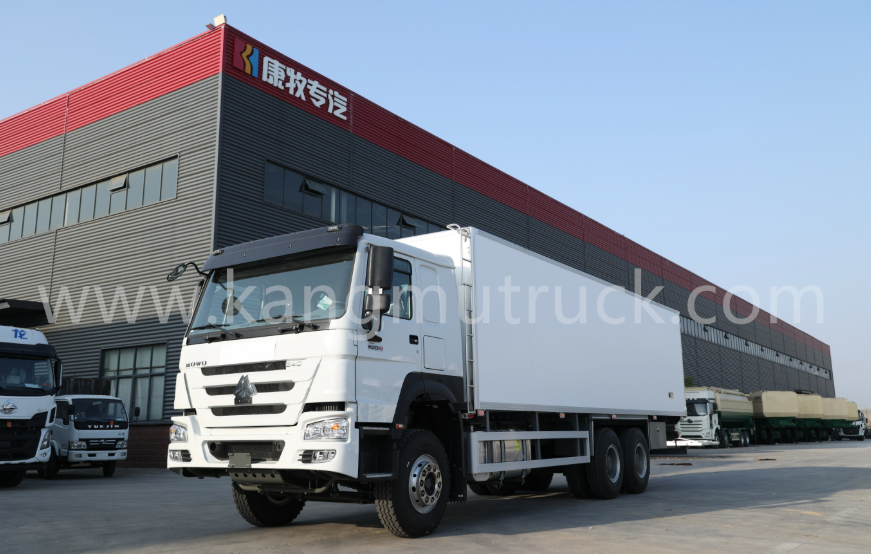
Cold chain work punishes hesitation. A 6x4 chassis puts drive torque through two rear axles instead of one, so when a driver edges away from a dock on packed snow or rain-slick concrete, the truck moves instead of spinning. Lighter single-drive trucks often need a running start or a cleared path; the 6x4 just digs in and goes. On farm pickups and back-of-store approaches where ice lingers in the shade, that extra bite saves time and keeps the refrigeration unit running on schedule.
Load capacity is not merely a spec sheet number. With two drive axles and a heavier frame, the 6x4 distributes a fully loaded reefer body more evenly, which reduces sway and squat. A lighter truck may hit its payload ceiling earlier, forcing route planners to split deliveries or run partial loads. The 6x4 handles full pallets of dairy, meat, or frozen produce without the rear end feeling loose over frost heaves and expansion joints. Drivers report less fatigue because the truck tracks straighter and brakes with more confidence when the trailer pushes.
Maintenance cycles also favor the 6x4 on cold chain routes. The extra axle spreads braking and driveline stress, so pads, rotors, and u-joints tend to last longer between replacements. In cold climates, road salt and gravel punish chassis components; the 6x4's sturdier suspension bushings and thicker frame rails resist that abuse better than lightweight counterparts. Over a five-year lease, the lower downtime and fewer surprise repairs keep temperature-sensitive cargo moving instead of sitting at a service bay.
Fuel Savings That Add Up Without Sacrificing Temperature Control
Every time a refrigerated trailer fires up its cooling unit, fuel disappears at a rate that would make most fleet managers wince. What if you could trim that cost without ever risking a load of temperature-sensitive cargo? The trick lies in smart airflow design and insulation that holds cold air like a thermos, so the compressor cycles less often. Drivers notice the difference at the pump, and shippers notice it in the invoices.
Think of it as tuning a guitar instead of buying a new one. By adjusting defrost timing, monitoring door seals for small leaks, and using bulkheads that match the load size, you can cut idle time and fuel burn by double digits. One fleet we know switched to a pulse-based temperature monitoring system and saw the cooling unit run 18% fewer hours per week—same setpoint, same load integrity, just fewer wasted cycles.
The real win is that you stop paying for overcooling. Many reefers work too hard because a cheap sensor drifts out of calibration or a side skirt is missing. Fix those small things and the compressor works smarter, not harder. In the end, you get lower fuel bills and a trailer that holds its temp like a champ, even in a Texas summer.
Temperature Monitoring That Works Silently Behind the Scenes
You rarely notice them, but small thermal sensors are already tucked inside server racks, vaccine fridges, and food transport units. They take readings every few seconds, compare them against tight thresholds, and log the data without needing anyone to press a button. The whole point is to stay out of the way until something drifts outside a safe band.
When a compressor starts to wear down or a cold room door is left ajar, the shift shows up as a subtle temperature curve long before it becomes a full failure. The system doesn't wait for a human to check a gauge. It quietly flags the anomaly, sends a note to the maintenance team, and keeps recording. That means busy staff can focus on their main work, not on babysitting thermometers.
Because the monitoring runs in the background, it adapts to different environments without needing constant recalibration. A slight drift in a laboratory incubator, a short power flicker in a pharmacy storage area, or a slow thaw in a delivery van all get caught the same way. The result is less noise, fewer false alarms, and a layer of protection that simply does its job.
One Refrigerated Setup Handles Dairy Deliveries and Pharmaceutical Runs Alike
Running milk crates at 36°F one morning and a pallet of insulin at 39°F that afternoon usually means two separate trucks, two drivers, and a lot of deadhead miles. The refrigerated setup here collapses that split. A single multi-zone reefer holds dairy on one side and pharmacy totes on the other, each with its own evaporator and airflow path. Dairy gets a high-humidity chill that keeps cartons from sweating; the pharma side runs a tighter band with logging every sixty seconds. The result is fewer reefer units idling at the dock and fewer hand-offs where temperature can spike.
What matters in practice is not just the setpoint but recovery time. After a dairy drop with the back doors open, the pharma compartment has to claw back to 2–8°C in minutes, not the half-hour many older units need. Pull-down tests after every route show the system returns to range before the next stop’s seal is broken. That consistency lets a single driver handle mixed routes without carrying dry ice or swapping trailers mid-day. It also removes the usual excuse for running two parallel cold chains when one well-specified rig can do both without compromise.
Maintenance Intervals Built Around Cold Chain Schedules, Not Just Mileage
Cold chain fleets often fall into the trap of following generic mileage-based maintenance plans. But a reefer unit that runs 10,000 miles on smooth highways faces very different wear than one logging the same distance through stop-and-go urban deliveries with frequent door openings. That's why smart operators now anchor their service intervals to actual cooling duty cycles—hours of compressor runtime, number of defrost events, and temperature pull-down frequency—alongside odometer readings.
Building the schedule this way means a truck that idles overnight at a distribution center gets its belts, hoses, and alternator checked sooner than one that only runs daytime routes. The fuel filters, air dryer, and liftgate hydraulic fluid are also tied to how hard the refrigeration system works, not just how far the wheels turn. This approach prevents both premature servicing and late interventions that risk cargo spoilage or roadside breakdowns.
Telematics data makes this practical. By pulling live metrics from the reefer controller and the chassis ECM, fleet managers can set alerts for when a unit hits 500 compressor hours or 30 defrost cycles, whichever comes first. Then the maintenance bay visit is scheduled around delivery windows and driver hours, not blindly at the next 50,000-mile mark. That keeps cold chain assets running reliably without wasting shop time or fuel on unnecessary trips.
FAQ
Its heavy-duty frame and dual rear axles give it the stability needed to carry a full insulated box without fishtailing on highways. The suspension is tuned to reduce road vibration, which matters a lot when you are hauling vaccines or fresh produce over long distances.
Depending on the reefer unit fitted, the box can hold temperatures from -20°C up to +20°C. The insulation is typically high-density polyurethane foam around 80 to 100 mm thick, so temperature recovery after door openings is quick, even in hot climates.
With a standard 40-foot or 9.6-meter box, the usable payload often lands between 15 and 18 tons, depending on the box build and reefer unit weight. The 6x4 layout handles that load much better than a 4x2, especially on gradients.
There is a penalty, but not a dramatic one if the unit is properly maintained. Many operators report an extra 2 to 4 liters per 100 km when the reefer is running hard. Choosing a unit with an economy mode and keeping the condenser clean helps control that cost.
Yes, the box can be split with movable bulkheads and separate evaporators. That lets one truck carry frozen goods in one section and chilled items in another, which is useful for food distributors who need fewer vehicles on the road.
Common choices include the Sinotruk D10 or D12 series diesels, with power ratings from around 270 to 420 horsepower. The higher-output versions are better for fully loaded refrigerated runs in mountainous regions, while the lower-output ones can save fuel on flatter routes.
The 6x4 traction and high ground clearance make it capable on gravel, mud, and poorly maintained access roads. The box mounting uses flexible connections to avoid cracking the insulation when the chassis twists, which is a common failure point on cheaper reefer trucks.
Pre-trip checks on the reefer unit, door seals, and drain holes make a big difference. Regular defrosting and keeping the evaporator fins clean prevent temperature drift. Also, calibrating the temperature recorder at least twice a year ensures the cargo stays compliant with food or pharma standards.
Conclusion
When the outside temperature climbs past 40°C, the HOWO 6x4's box doesn't flinch. Its panels combine high-density polyurethane foam with a reinforced skin that blocks heat transfer far better than thinner builds, and the extra sealing around door edges stops warm air from bleeding in during multi-stop routes. The 6x4 chassis earns its keep here too — a stiffer frame and double rear axles handle washboard roads and heavy payloads without twisting the cargo area, which keeps the door alignment tight and the cold envelope intact. On top of that, the engine and compressor are tuned as one system rather than bolted together as an afterthought, so the truck sips less diesel while maintaining a steady setpoint, even when the reefer unit cycles hard in summer traffic.
Behind the scenes, a multi-zone temperature logger records conditions every few minutes and pings the driver only if a real deviation occurs, not with constant false alarms. That quiet reliability matters because one setup often jumps between ice cream loads, fresh dairy, and temperature-sensitive pharmaceuticals on the same week. The box's interior is smooth and drain-friendly, so changing from milk crates to medical pallets doesn't mean a day lost to cleaning. Maintenance follows cold chain rhythms instead of odometer numbers alone: condenser fins, door gaskets, and reefer belts get checked on a schedule tied to actual refrigeration hours and delivery cycles, cutting downtime between peak dairy runs and urgent medicine hauls.
Contact Us
Contact Person: Shen Zhikang
Email: [email protected]
Tel/WhatsApp: 8613908668969
Website: https://www.kangmutruck.com/