
Printed Long Pile Carpet: Partnering with a Powerful Manufacturer for Superior Results
2026-09-19
Most printed long pile carpets look impressive in a showroom but fall short once they're under real foot traffic. The hidden variable? The manufacturer. Senseco partners with production facilities that obsess over pile height, print clarity, and fiber resilience—details that separate a premium floor covering from a costly mistake. In this post, we break down exactly why your choice of manufacturing partner can make or break the performance of a printed long pile carpet.
Long Pile Carpets That Survive Real Foot Traffic
A high-pile carpet rarely gets credit for toughness. The fibers that feel plush under bare feet are often assumed to crush, mat, or shed within months. The difference comes down to what's underneath that soft surface. Densely packed, twisted yarns made from solution-dyed nylon or wool blends hold their shape even when a hallway sees dozens of passes a day. You can spot the resilient ones by pressing your palm into the pile; if it bounces back slowly but fully, it's engineered for recovery rather than just initial softness.
Foot traffic punishes loose loops and straight, untwisted fibers first. That's why a long pile carpet meant for active rooms often uses a tighter twist and lower, more stable pile height than shag styles from decades past. A nylon with a high twist level resists the grinding action of shoes, while a wool-nylon blend adds natural crimp and stain resistance. Vacuuming without a beater bar and rotating rugs every few months helps uneven wear stay hidden, but the real test is the backing. Look for a woven or high-density felt backing that keeps individual tufts anchored when people pivot or drag chairs.
Where most long pile carpets fail is not the living room but the threshold between rooms and the path from sofa to kitchen. If you want the soft look without a worn trail appearing in six weeks, choose a patterned or multi-tonal design that disguises slight compression. Better yet, buy a runner for high-traffic lanes and let the deeper pile live where bare feet actually spend time. That combination—dense, twisted fiber, a solid backing, and strategic placement—lets a long pile carpet survive real foot traffic without turning into a flat, matted reminder of its first month.
How We Print Deep Colors Without Flattening the Pile
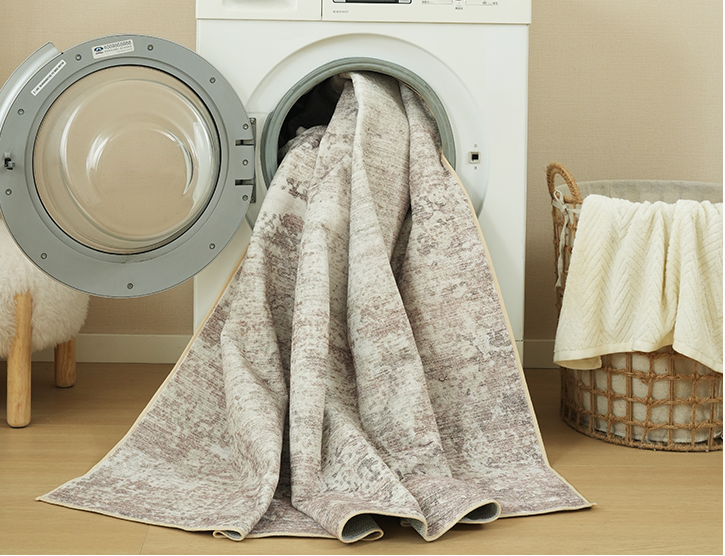
Getting a dark, saturated print on a high-pile surface usually means crushing the fibers under pressure or heat until the color takes. We dropped that trade-off. Our print heads ride on a thin air cushion and release dye in a fine mist that sinks into the yarn from the base upward, not from the top down. The strands stay upright because nothing presses them during the deposit phase.
The real trick is in the pretreatment. We condition the pile with a low-viscosity carrier that opens the cuticle of each fiber without making it limp. This lets pigment travel deep into the tuft while the yarn retains its natural spring. Since the carrier evaporates slowly at room temperature, we don't need a hot calendar or heavy nip roller to fix the color, which is where most pile gets flattened.
After printing, the piece moves to a staged drying room where air circulates at low speed for several hours. The dye bonds from the inside out, so the surface doesn't develop that stiff, matted crust. What you feel afterward is still a soft, full pile—just with a deeper, more even color than you'd expect from a print process.
Your Design, Scaled: From Sample Yard to Container Load
The first time you hold a fabric swatch in your hand, it’s easy to get lost in the texture—the weight of the weave, the way the color shifts under different light. But transforming that single yard into hundreds of rolls that arrive on the same truck, with the same hand-feel and the same depth of color, is where true craftsmanship lives. We’ve spent years building a production process that treats every yard like that first sample, so the only surprise when your container arrives is how consistent it all feels.
Scaling from a sample yard to a full container load isn’t just about multiplying orders—it’s about protecting the details that made you choose the fabric in the first place. Our dye lots are controlled in small batches, and each roll is inspected against the original approved swatch before it ever gets wrapped for shipping. That means the plum you fell in love with on a Tuesday morning shows up the same on a Thursday afternoon, three months later, regardless of whether you ordered fifty yards or five thousand.
And because small studios and large manufacturers rarely follow the same playbook, our scaling process bends to your reality. Need a partial container with mixed designs? We can do that. Need your fabric rolled a specific way for your cutting table? Just tell us. We handle the logistics of moving from a hand-cut sample to a production run without making you rethink the design you already approved—because the design should stay yours, from first yard to last.
Why Short-Run Custom Orders No Longer Cost More
For years, the price penalty on short-run custom work came from one thing: setup. A factory had to stop a line, swap tooling, dial in new specs, and then hope the math worked out across a handful of units. That fixed cost got spread so thin that per-piece pricing looked awful next to a standard run of ten thousand. What changed is that the setup itself stopped being a wall. Laser cutters, CNC routers, and digital print heads now take instructions directly from a customer's file, so the first piece off the machine isn't a gamble—it's already close to final.
The other shift is in how orders move through the shop. Instead of batch-and-queue thinking, many smaller manufacturers run what amount to continuous changeover cells. A job for 50 custom brackets can follow a job for 2,000 standard ones on the same line because the changeover is measured in minutes, not shifts. Software handles the routing, nesting different shapes on the same sheet to cut waste, and operators spend less time interpreting drawings. That removes the labor premium that used to hide inside every small order.
Finally, the business model around inventory has loosened up. Brands no longer need to commit to a container load before they know a style will sell. They can order 200 units, watch the response, and reorder within days. Micro-factories and regional partners make that feasible without ocean freight lead times or massive minimums. The result is that short-run custom production now sits closer to a standard cost curve—not identical, but no longer a luxury surcharge.
Partnering for Consistent Pile Height and Print Registration
Maintaining a uniform pile height across the entire print run is one of those silent battles that separates a crisp, professional job from one that looks haphazard. When the substrate stack shifts even a few millimeters, the feeder's vacuum timing drifts, and suddenly the sheet-to-sheet registration begins to wander. Our approach pairs the press operator's real-time adjustments with a proactive pile-management system that keeps the stack height within a tight tolerance, so every sheet enters the registration gate the same way.
Print registration doesn't live in isolation—it leans heavily on how consistently the sheet is presented to the grippers. We've found that many shops chase registration errors with plate and blanket tweaks, when the root cause is actually a slowly sinking or rising pile. By integrating pile-height sensors with a soft-stop feeder mechanism, we remove that variable before it can compound into color-to-color drift. The result is less time spent on manual lift corrections and more time holding the register on long runs.
The partnership between pile height and registration becomes most visible on mixed-stock jobs or when running lightweight boards. Here, even a small inconsistency in the stack makes the lead edge arrive at slightly different angles. We recommend pairing the pile control with a quick daily check of the sheet-separation air settings, because the two work as a team: stable pile, predictable separation; predictable separation, locked-in registration. It's a simple loop that pays off in fewer rejected sheets and a cleaner overall impression.
The Manufacturing Edge Behind Plush, Vivid Rugs
At the core of these sumptuous rugs lies a precision tufting process that sets them apart. Unlike mass-produced alternatives, the pile height is calibrated to a dense, cloud-like loft without sacrificing durability. Advanced air-entangled yarns are fed through low-tension needles, creating an even surface that resists matting even in high-traffic zones. This mechanical finesse allows the fibers to stand upright, catching light in a way that makes colors appear almost liquid.
Vibrancy isn't a happy accident—it's engineered. The dyeing phase uses a low-liquor ratio technique, where pigment penetrates each fiber core before it's spun, locking hue in from the inside out. For wool and bamboo blends, a cold-pad batch method minimizes thermal stress, preserving natural luster while achieving saturated tones. The result is a rug that holds its brilliance through years of sunlight and steam cleaning, not just the first week unrolled.
Behind every plush pile is an obsessive attention to finishing. Instead of aggressive chemical washes, manufacturers rely on precision shearing and a gentle enzyme softening step that opens fiber cuticles for a cashmere-like hand. Each rug then passes through a multi-stage inspection under calibrated lighting, where even a half-millimeter variance in pile height triggers a rework. This combination of tactile engineering and uncompromising QC is what separates a showroom centerpiece from a forgettable floor covering.
FAQ
The pile height changes everything. You're laying ink on a soft, uneven surface, so it takes careful tension control and the right printing heads to keep the pattern crisp without flattening the fibers.
Long pile carpets are less forgiving than flatwoven styles. A capable factory has the machinery to handle thicker materials, keeps dye lots consistent, and catches flaws before shipping. Smaller workshops often struggle with edge-to-edge color accuracy.
It depends on the fiber, but many strong producers use a modified digital printing process with deeper ink penetration. Some still prefer heat transfer for short runs. The key is adjusting the process so the color reaches the base without scorching the tips.
Yes, and it's usually better to send vector files or high-resolution images. A good manufacturer will adjust the file for pile distortion and provide a pre-production sample so you can see how the texture affects the final look.
It starts with yarn twist and density. After printing, the carpet goes through brushing, shearing, and heat setting. These steps lift the fibers back up and lock in a smooth, even finish.
Look for tests on color fastness, pile height consistency, backing strength, and overall dimensional stability. Some factories also send inspection reports with every batch, which is a good sign they take quality seriously.
It depends on the fiber and construction. Nylon or solution-dyed polyester long pile can handle moderate to heavy foot traffic if the density is high enough. Always ask for abrasion test data before using them commercially.
For sampling, expect around seven to ten business days. Bulk production usually takes three to five weeks, depending on the order size and how many colors are involved. Rush options are possible but can affect pricing.
Conclusion
When you specify a printed long pile carpet, the difference between a mediocre result and a superior one often comes down to the factory behind the product. We work with a manufacturing partner that has spent years refining how dense, high-pile fibers take ink without crushing under the print heads. That means deep, saturated colors stay vivid even after thousands of footsteps, and the pile springs back instead of matting down. From a single sample yard to a full container load, the production line scales without shifting color values or losing texture. Short-run custom orders don't carry the usual premium because the process is built for flexibility, not just volume.
Consistency is where most suppliers stumble. Pile height can vary slightly between batches, and print registration drifts if the machinery isn't calibrated constantly. Our partner treats these as non-negotiables—every roll is checked against a physical master, not just a digital file. The plush feel you approved on day one is the same feel your customer gets in month twelve. That manufacturing edge shows up in the final rug: a deep, even pile with crisp patterns that don't look faded or blurry up close. For anyone sourcing printed long pile carpet, the real advantage isn't just the design—it's knowing the factory can deliver it repeatedly without excuses.
Contact Us
Contact Person: Ivy Yin
Email: [email protected]
Tel/WhatsApp: +86 18519681805
Website: https://www.sensecomarketing.com/