

OEM Flange Penstock Gate Solutions for Reliable Water Control
2026-11-02
Specifying the right flange penstock gate isn't just about dimensions on a drawing—it's about trusting that the gate will hold when water pressure spikes, debris accumulates, or maintenance windows shrink. That trust is what drives our OEM approach at THT. In this article, we explore how reliable water control starts long before installation, and why off-the-shelf thinking rarely survives contact with real canals, dams, and treatment plants.
Flange Penstock Gates Tailored to Your Exact OEM Specs
Flange penstock gates built around your drawings, not our assumptions. Every face-to-face dimension, drilling pattern, and seal groove is machined to match the OEM interface you already have in the field, so replacement drops in without reworking the wall thimble or adapter ring.
Material choices follow the service conditions rather than a default catalog line. Cast iron, ductile iron, stainless steel, or aluminum can be paired with wedge faces, bottom seals, and stem extensions that match the original operating torque and leakage class. We keep a record of your custom geometry and surface finish, which makes repeat orders identical to the first batch.
Your internal part number, paint spec, and packaging instructions are carried through the shop order and the inspection report. That means a gate from us looks, fits, and performs like the unit your maintenance team already knows, without forcing you to adapt to a standard product.
Why Flanged Ends Beat Field Welding for Water Control Gates
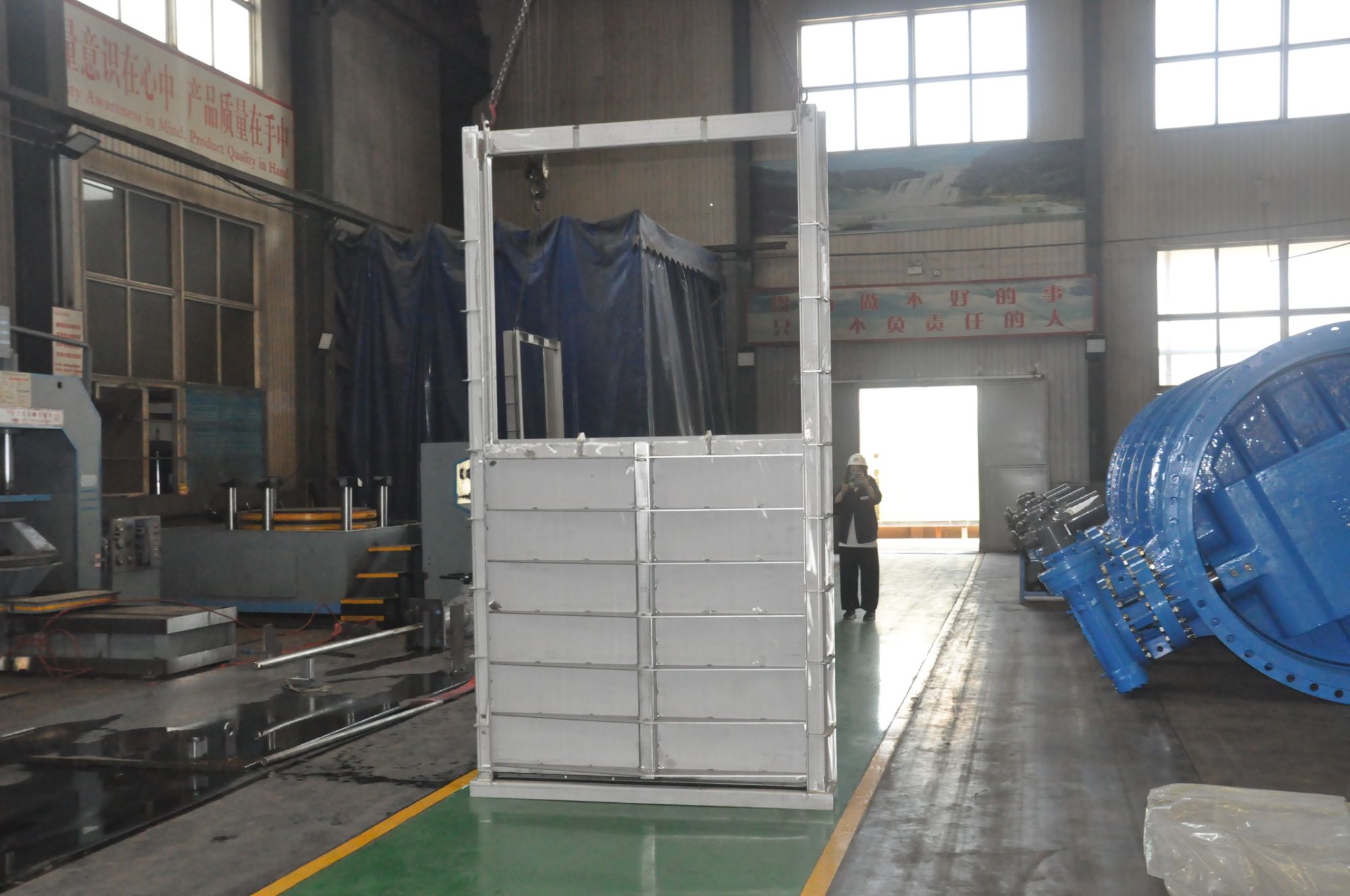
Field welding on water control gates often sounds like a rugged, permanent solution, but it brings a host of problems that don't show up until the gate is already in service. Heat from welding can warp the gate frame, throw off seal alignment, and create residual stresses that lead to cracking near the welds over time. And once a gate is welded into place, removing it for maintenance means cutting through steel while standing in a wet, confined space—slow, dangerous, and expensive.
Flanged ends change that equation completely. A gate with flanged connections bolts directly to the pipe or wall flange using a gasket, so installation is fast and doesn't require certified welders on site. Alignment stays true because there's no heat distortion, and if the gate ever needs to be pulled for seat replacement or debris clearing, you unbolt it, lift it out, and bolt it back in the same day. No grinding, no re-welding, no waiting for inspections.
For utilities and plants that can't afford extended downtime, flanged ends are the practical choice. They reduce installation labor, eliminate weld-related corrosion risks at the joint, and allow future modifications without cutting into the pipeline. When you compare total lifecycle cost—including maintenance access, repair time, and the risk of weld failure—flanged connections routinely outperform field-welded gates in both reliability and long-term value.
Precision Seating That Keeps Water Exactly Where You Want It
The seat's lip doesn't just rest against the rim—it locks into a subtle groove that runs the entire circumference. That groove catches the edge and holds it there, so even when you shift your weight, the seal stays tight. No micro-gaps, no slow drips sneaking down the porcelain.
Inside, the inner slope angles downward just enough to guide every drop toward the center channel. Splashback becomes a non-issue because the water meets a curved deflector before it can bounce outward. You get the full rinse without the usual wet floor ritual.
After dozens of flushes, the seating still feels snug. The material has a slight give that remembers its shape, so it doesn't warp or harden over time. Water goes where you aim it, every time, and the only thing you'll wipe down is the seat itself—not the surrounding tiles.
Materials That Laugh at Corrosion and Constant Submersion
Drop a standard steel bolt into seawater and it starts rusting within hours. Yet certain materials sit submerged for decades without losing strength or appearance. The difference lies in how they interact with oxygen, salt, and aggressive ions. Corrosion-resistant alloys such as 316 stainless steel and titanium form a thin, self-healing oxide layer that blocks further attack. When that layer gets scratched, it reforms almost instantly in the presence of oxygen, which is why these metals shrug off conditions that would destroy ordinary carbon steel.
Polymers and composites take a different route: they simply ignore the chemistry of water. High-density polyethylene, PVC, and fiberglass reinforced plastic do not conduct electricity the way metals do, so galvanic corrosion cannot occur. They also resist biofouling to a surprising degree, though a surface film may develop over time. In underwater applications where weight matters—like remotely operated vehicles or buoy components—these materials avoid both corrosion and the extra mass of heavy alloys.
Choosing the right material for constant submersion means weighing environment, load, and lifespan. Titanium handles deep-sea pressure and saltwater better than almost anything else, but its cost limits it to critical parts. Marine-grade aluminum works well above the waterline but can pit if continuously wet unless protected. Smart designs often combine materials: a stainless steel shaft, a polymer housing, and titanium fasteners. Understanding these tradeoffs is what separates a structure that lasts decades from one that fails in a season.
From Flood Basins to Treatment Plants: Real-World Gate Deployments
In flood basins, gate deployments rarely follow a neat spec sheet. These structures are expected to hold back debris-laden runoff, survive long dry spells, then move without warning when a storm hits. Many districts choose cast-iron slide gates with heavy-duty frames because they tolerate silt buildup and occasional impact from branches better than lighter alternatives. Maintenance crews often find that the real challenge isn't the gate itself but the accumulated sediment around the guides.
Treatment plants invert the priority list. Here gates are smaller, but they cycle far more often and operate in corrosive environments. Aeration basins, chlorine contact chambers, and return sludge lines all depend on gates that can hold a set position for weeks, then adjust by a few inches without leaking. Stainless steel or aluminum gates with polymer seals tend to dominate because they resist chemical attack and don't need lubrication every month.
Some utilities run both extremes on the same site. A combined sewer overflow facility might use massive flood-control gates during wet weather and pivot to fine throttling at the headworks the next morning. In those cases, operators lean on position feedback and local control panels more than any single material choice. What works in a debris-filled basin often fails in a quiet clarifier, and vice versa.
Engineering Support That Feels Like an Extension of Your Team
When you bring a problem to us, it doesn't disappear into a queue or get handed off to someone who has to relearn your stack from scratch. We sit in on your standups, read your runbooks, and get to know the quirks of your system until we can anticipate what you'll ask before you ask it. The goal isn't to close tickets quickly—it's to make the support layer feel like the teammate you'd grab for a whiteboard session.
That means continuity. The engineer who helped you last month still remembers why you pinned that dependency or why the retry logic is set the way it is. When something breaks at an inconvenient hour, you aren't starting from zero—you're picking up a conversation that never really ended. We keep notes, share insights across your account, and bring the same curiosity we'd bring to our own production incidents.
Over time, this changes the rhythm of collaboration. You stop writing long context paragraphs in every message and start sharing half-formed ideas, knowing we'll fill in the blanks. We'll push back when we see a risk, suggest a cleaner path when it matters, and ship the boring but critical follow-ups without being asked. That's what an extension of your team should feel like: not a vendor you manage, but a bench you can rely on.
FAQ
The main difference comes down to the mounting design. A flange penstock gate has flat, drilled flanges around the frame, so it can be bolted directly to a mating flange on the pipe or wall. This gives a stronger, leak-resistant connection than slide-in or wedge-mounted gates, especially when you need to handle higher pressure or frequent operation.
Yes, that's one of the key advantages of working with an OEM supplier. You can specify exact flange dimensions, bolt hole patterns, and frame widths. Many manufacturers will also adjust the gate's height, sealing material, and stem length to fit your existing infrastructure rather than forcing you to adapt the site.
You'll typically find cast iron, ductile iron, and stainless steel options. Cast iron is cost-effective for clean water, ductile iron adds more impact resistance for heavy-duty use, and stainless steel (usually 304 or 316) is best for corrosive environments or wastewater with chemical exposure. The seals can be EPDM, NBR, or metal-to-metal depending on leakage requirements.
Rising stems are easier to visually confirm the gate position because the threaded stem extends above the actuator. They need vertical clearance. Non-rising stems keep the stem length fixed and are better for tight spaces or buried installations. If your gate is in a vault or under a walkway, go with non-rising; for open-air channels, rising is usually simpler to operate.
Routine maintenance is fairly light but important. Check the seal faces for debris or scoring every few months, lubricate the stem threads, and exercise the gate fully open and closed at least twice a year to prevent seizing. If you use a gearbox or electric actuator, follow the manufacturer's schedule for oil or grease changes. Most problems come from neglect, not design flaws.
You'll see them in municipal water and wastewater treatment, flood control, hydropower intake structures, irrigation districts, and industrial cooling water systems. Basically anywhere you need to isolate a channel or pipe with reliable, long-term water control, a flanged gate is a common choice because it handles both low and moderate head pressures well.
Look beyond the initial price. Ask about their experience with similar head pressures, whether they provide CAD drawings and dimensional checks before production, what testing they perform (like hydrostatic tests on the seal), and how they handle after-sales support. A good OEM will offer design flexibility, clear communication, and documented quality control rather than just a catalog product.
Conclusion
Flange penstock gates built to OEM specifications do more than fill a slot in a water control system—they turn a standard component into a deliberate part of your infrastructure. Instead of forcing field crews to weld cast-iron or stainless assemblies in place, which introduces heat distortion, uneven stress, and scheduling chaos, flanged ends let you bolt the gate directly onto a mating surface with nothing but a torque wrench and a gasket. That simple shift shortens installs from days to hours and lets you pull a gate for inspection without cutting steel or draining an entire basin. The seating faces are machined flat and lapped to match the frame, so a closed gate holds back water with almost no weepage, even after thousands of cycles. When you combine ductile iron bodies, 316 stainless stems, and EPDM or NBR seals chosen for the specific chemistry of your water, the result is a gate that shrugs off constant submersion, treats chlorides and sulfates as minor annoyances, and keeps doing its job long after cheaper alternatives have pitted and seized.
These gates earn their keep in a wide range of real deployments: flood basins that wait dry for half the year then hold back a storm surge, wastewater treatment plants where grit and rag balls try to jam every moving part, irrigation canals that run season after season without a break, and industrial intake structures where downtime means lost production. In each case, the flange gate becomes the silent, reliable boundary between where water should be and where it must never go. And because no two plants, basins, or canals are truly identical, working with a manufacturer that treats your drawings and load cases as their own—not as a ticket to a generic catalog part—changes the entire project. You get material substitutions that actually make sense for your water chemistry, stem extensions and lifts sized for your operators, and clearance envelopes that fit your existing concrete. That kind of engineering support feels less like a vendor relationship and more like adding a dedicated water-control specialist to your own team, one who already knows your specs before you finish the sentence.
Contact Us
Contact Person: Su Zhang
Email: [email protected]
Tel/WhatsApp: +86-25219206
Website: https://www.tht-valve.com/