
Custom Gold Plating Production Line Solutions for Precision Manufacturing
2026-08-20
Precision manufacturing demands more than just a standard gold plating line—it requires a system engineered around your exact tolerances, throughput, and product geometry. Yet too many facilities still force their production into off-the-shelf equipment, sacrificing yield and finish quality. Junda approaches custom gold plating differently: every line is designed from the ground up to match your process, not the other way around. In this post, we break down how tailored gold plating solutions eliminate common bottlenecks, improve deposit uniformity, and deliver measurable ROI for high-precision components.
Designing Tank Sequences Around Your Tightest Dimensional Specs
When every millimeter counts, starting with the most restrictive tank dimension flips the usual design order. Instead of letting process volume dictate geometry, pin down the diameter or height that cannot change first. That single hard number then drives nozzle placement, baffle orientation, and even the sequence of fabrication steps, so downstream adjustments never cascade into rework.
A practical approach is to map each tank’s tolerance stack before layout begins. Identify which surfaces share reference datums and which ones drift independently. For tight annular spaces or fixed pipe rack elevations, assign those dimensions as master constraints and let less critical zones absorb variation. This keeps the overall sequence buildable without forcing every feature to hold an unnecessarily tight band.
Finally, build the installation and welding order around the dimensions that are hardest to correct later. If a nozzle must align to a pump within a few millimeters, set that joint after the shell has settled and been surveyed, not before. Sequencing the work so that the tightest fits come last gives you room to compensate with shims or minor field adjustments, which is often far cheaper than trying to machine every component to perfection up front.
Gold Bath Formulation for Uniform Deposition on Micro-Details
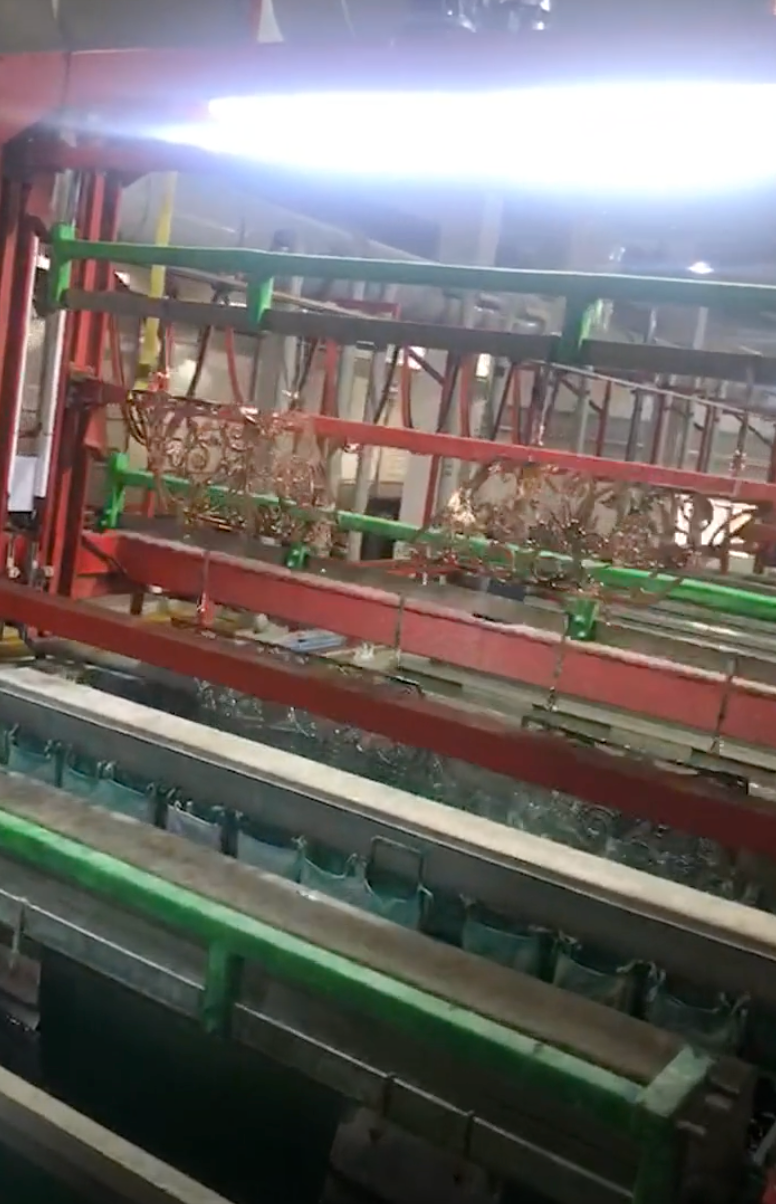
Getting gold to plate evenly across micro-details usually starts with the free cyanide-to-gold ratio rather than the gold concentration itself. Keeping the bath slightly acidic with a citrate or phosphate buffer stabilizes the complex and improves throwing power into recessed areas, while too much free cyanide starves sharp corners and too little leaves rough edges.
Trace additions of thallium or bismuth, often below 10 ppm, refine the grain and shift the deposition potential so high-current-density tips stop stealing thickness from valleys. A non-ionic wetting agent helps the solution enter narrow trenches and blind vias without hydrogen bubbles sticking to the surface, which would otherwise leave micro-voids.
Pulsed current with short forward pulses and a brief off-time or reverse pulse lets the diffusion layer relax, preventing local depletion inside fine geometries. Combined with gentle agitation and a bath held between 50 and 60 °C, this produces a bright, even gold layer that preserves the original micro-detail instead of blurring it.
Fixturing and Masking That Keep Unplated Zones Pristine
Effective fixturing starts with understanding how the part sits in the plating bath and where the current density will cause build-up. A well-designed rack or jig will hold the component firmly while exposing only the surfaces intended for plating. For irregular shapes, custom contacts that grip near non-critical areas reduce the risk of shadowing or burning, and they help prevent creeping of the deposit into recesses. The goal is not just coverage but a crisp boundary between plated and unplated zones, which requires repeated adjustments to contact pressure and position.
Masking materials need to match the chemistry and temperature of the bath. Vinyl tapes, liquid lacquers, and wax formulations each behave differently under aggressive electrolytes, and choosing one without testing can lead to peeling or undercutting at the edges. Many plating shops rely on a combination: a narrow tape line for precise borders, then a broader wax or paint layer to seal the rest. The skill of the operator shows in how evenly the mask is applied—any trapped air or tiny wrinkle becomes a path for solution to wick underneath, ruining an otherwise clean edge.
Routine inspection of fixtures and masks is what keeps results consistent over long production runs. Clamps lose tension, rack coatings crack, and tape adhesives degrade after repeated exposure to heated baths. A quick visual check between cycles, along with re-masking any area that shows lifting, prevents most defects before they happen. Rather than treating fixturing as a one-time setup, shops that track wear patterns and adjust early find that unplated zones stay pristine without relying on touch-up work later.
Line-Scale Automation Without Losing Manual Process Control
Many line-scale automation projects fail because they treat manual control as a relic. The better approach is to keep the operator’s hands in the loop where it matters. For instance, a packaging line might run conveyors and fillers automatically, but the sealing station still has a manual jog wheel that lets a veteran worker nudge alignment when a new film roll behaves differently. That small override doesn’t stop the line; it just bends the automation to match real material conditions.
One practical pattern is layered control. The PLC handles high-speed sequencing, while the HMI exposes a set of manual trim pots—not buried menus—for speed, dwell time, and temperature offset. Operators can switch a single station to semi-auto, make a change on the fly, and the system stores that offset for the rest of the shift. Nobody has to call an engineer or re-upload a recipe, and the production pace stays intact.
Some plants use an 'auto-run, human-confirm' rhythm. The machine loads, processes, and unloads parts without waiting, but at a critical quality gate it pauses for a two-second visual or tactile check. The operator taps a confirm button, and the cycle continues. This keeps line-scale throughput while making human judgement a built-in quality gate rather than an afterthought.
Pre-Treatment Steps That Improve Adhesion on Exotic Alloys
Getting paint or adhesive to bite into titanium, Inconel, or cobalt-chrome isn’t just about scuffing the surface. The same oxide layers that give these alloys their corrosion resistance act as a barrier. A practical pre-treatment sequence starts with solvent degreasing to pull off machining oils, followed by an alkaline cleaner to remove shop grime. Rushing this step and going straight to abrasive blasting often just works the contaminants deeper into the metal.
Once the surface is genuinely clean, mechanical etching creates a physical profile the coating can grip. Aluminum oxide grit blasting is common, but on high-nickel alloys the blast pressure and angle need careful control—too aggressive and the surface smears instead of roughening. For titanium, a light alumina blast followed by a nitric-hydrofluoric acid pickle removes that smeared layer and exposes reactive sites. Shops that want to avoid hydrogen embrittlement sometimes swap the acid pickle for an alkaline-peroxide etch.
Chemical conversion coatings and coupling agents are often the difference between marginal adhesion and a bond that survives thermal cycling. A chromate or zirconium conversion layer gives the adhesive a chemical anchor, not just a mechanical one. Silane or titanate primers can bridge the inorganic alloy surface and the organic adhesive, especially on magnesium or aluminum-lithium grades. Even the rinse matters: a final DI water rinse and immediate drying prevent rapid re-oxidation, because the delay between prep and bonding has a direct impact on peel strength.
Expanding Capacity by Retrofitting Existing Lines, Not Rebuilding
Retrofitting an existing manufacturing line often makes more sense than starting from scratch when you need more output. A complete rebuild ties up capital for months, disrupts your workforce, and forces you to re-negotiate permits, utilities, and floor space. By contrast, targeted upgrades—replacing bottleneck machines, adding inline inspection, or rebalancing workstation tasks—can unlock 15 to 30 percent extra capacity without moving a single wall.
The real trick is mapping where the constraint actually lives before you spend anything. Most lines have one or two stations that throttle the rest, and retrofitting those specific points yields disproportionate gains. Sometimes that means swapping a legacy conveyor for a modular one, or pulling an old hydraulic press out and dropping in a servo-driven unit that cycles twice as fast. You keep the building, the power feed, and the operator training, which cuts commissioning time by more than half compared to a greenfield installation.
That said, retrofitting is not always the cheap shortcut it appears to be. Hidden issues like outdated control cabinets, floor-loading limits, or incompatible safety systems can turn a simple upgrade into a domino project. Smart teams run a full audit of the line’s electrical, mechanical, and data layers first, then phase the retrofit during scheduled downtime. Done well, capacity grows in the same footprint with far less risk and capital outlay than tearing everything down.
FAQ
Standard lines often force you to adapt your parts to the equipment. A custom line is built around your specific part geometries, racking needs, and throughput targets. That means tighter control over current distribution, better throwing power in recessed areas, and fewer rejected parts due to thickness variation.
We use a combination of pulse plating, custom-designed anodes, and part-specific fixturing. Before finalizing the layout, we run plating trials with your actual components to map thickness across the surface. Then we fine-tune the rectifier settings and agitation patterns until the variation falls within your tolerance band.
Medical device manufacturers, aerospace suppliers, semiconductor packaging, and high-reliability electronics are the main users. Anywhere a few microns of gold has to survive repeated thermal cycling, vibration, or aggressive environments, a purpose-built line becomes essential rather than optional.
You're also paying for the engineering time spent on process development, custom racking, automation programming, and validation runs. Materials matter too: titanium heating coils, PP or PVDF tank liners, and precision dosing pumps all add cost but extend service life and reduce maintenance downtime.
Yes, if the initial design leaves room for it. We typically reserve space for robotic hoists, extra sensors, and software modules from day one. That way you can prove out the chemistry and process parameters with a smaller investment, then scale up without ripping out the core infrastructure.
Everything from real-time thickness readings via XRF to bath temperature, pH, and current density logs. Each batch gets a unique ID linked to the process parameters, so if a deviation shows up later, you can trace it back to a specific shift, tank, or operator action.
A typical mid-size line takes between ten and sixteen weeks. That includes finalizing the process flow diagram, fabricating tanks, installing the electrical and automation systems, and running a full qualification batch with your parts. More exotic chemistries or cleanroom integration can push it to twenty weeks.
Most customers need either hard gold for wear resistance or soft gold for wire bonding. The line can be configured with separate tanks for both, plus a nickel or palladium underplate station. Switching between baths is handled by the automated hoist schedule, so you don't have to manually move racks between tanks.
Conclusion
For precision manufacturing, a custom gold plating line starts with tank sequencing that respects the tightest dimensional tolerances—every station is positioned so that solution exposure time and temperature gradients don't push parts out of spec. The gold bath itself is formulated for micro-level uniformity, using additives that suppress edge buildup and ensure even deposition inside recessed features. Before plating, pre-treatment steps are tuned for exotic alloys, often involving proprietary activators and strike layers that promote adhesion without etching delicate surfaces.
Fixturing and masking are engineered to keep unplated zones pristine, with reusable shields that follow complex part geometry and prevent bleed under coatings. Automation on the line is scaled to remove repetitive handling, yet manual override points are preserved so operators can adjust current density or rack positioning mid-run when a high-value part demands it. When capacity needs grow, retrofitting existing tanks and rectifiers—rather than rebuilding from scratch—lets a shop add plating cells or upgrade filtration without losing floor space or requalifying every process. This blend of process control and flexible hardware is what separates a truly custom line from a catalog solution.
Contact Us
Contact Person: hayyr
Email: [email protected]
Tel/WhatsApp: 8613082110525
Website: https://www.jundaelectroplating.com