

China Aixtron G5+ GaN Epitaxy Susceptor: Key Insights for Advanced Semiconductor Manufacturing
2026-11-16
As China's compound semiconductor industry shifts into high-volume GaN production, the Aixtron G5+ platform has become a reference point for epitaxial uniformity and throughput. Yet even the most advanced reactor is only as stable as the susceptor inside it. In this post, we unpack what makes the G5+ GaN epitaxy susceptor a critical consumable—from thermal uniformity and SiC coating integrity to lifetime under aggressive NH₃/H₂ cycling. Along the way, we look at how Semicorex and other specialized suppliers are closing the performance gaps that directly affect yield.
How the G5+ Susceptor Changes GaN Uniformity in China-Based Fabs
The G5+ susceptor reworks thermal distribution inside the reactor by flattening the radial temperature profile that older pocket designs leave uneven. Instead of relying on a uniform heating coil assumption, its revised pocket depth and edge lip pull heat away from the wafer rim just enough to cancel the classic cold-edge effect. For GaN MOCVD, that directly reduces thickness variation across a 6-inch wafer, keeping the central and outer zones within a much tighter growth-rate window.
In China-based fabs, where tool uptime and wafer cost per run dominate daily decisions, this shift matters more than a lab demo would suggest. Many lines still push older reactors with drifting heater zones, and operators compensate by widening the process tolerance. The G5+ susceptor gives them back that margin without a full chamber rebuild, cutting the need for frequent recalibration runs and lowering the scrap rate linked to non-uniform doping in the buffer and channel layers.
The visible result on the production floor is a tighter distribution of sheet resistance and a smoother epi surface after the cap layer. Engineers notice fewer edge-exclusion rejections and more consistent forward voltage yields on subsequent LED or power device steps. While no susceptor alone fixes every uniformity issue, the G5+ removes one of the heavier variables in the thermal stack, which is exactly the kind of incremental gain that keeps high-volume Chinese fabs competitive on both cost and quality.
Thermal Design and Material Choices Inside the Aixtron G5+
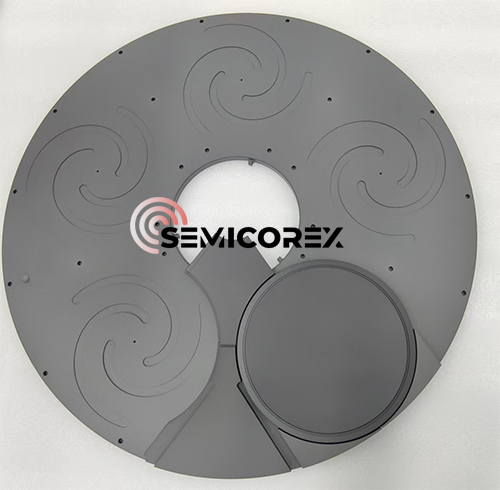
The thermal management inside the Aixtron G5+ begins with a carefully engineered quartz ceiling that sits directly above the wafer pocket. Rather than relying on a single heating zone, the reactor splits the heat load across multiple, independently controlled filaments. This approach prevents the kind of radial temperature drift that often shows up as thickness non-uniformity near the wafer edge. Quartz was chosen not only for its transparency to the infrared radiation used in pyrometry, but also for its low thermal expansion, which keeps the geometry stable even when the chamber cycles between deposition and cleaning temperatures.
Below the wafer plane, the susceptor material plays an equally important role. Aixtron moved away from solid graphite carriers and instead uses a graphite core coated with a dense silicon carbide layer. The SiC coating acts as a barrier against the aggressive chemistry of ammonia and hydrogen at high temperature, while the graphite underneath provides the mechanical stiffness needed to avoid sagging over repeated thermal cycles. Small purge channels machined into the susceptor rim direct a thin stream of inert gas outward, creating a local pressure differential that discourages parasitic deposition on the carrier's underside.
One often overlooked detail is the choice of metallic components in the gas injection flange. Standard stainless steel can release trace iron and chromium when exposed to hot ammonia, but the G5+ uses a high-nickel alloy that resists nitridation far better. This prevents metal contamination from reaching the wafer surface and also extends the interval between chamber wet cleans. Combined with the quartz ceiling and SiC-coated susceptor, these material decisions keep the thermal budget predictable run after run, which is why the platform handles both GaN-on-SiC and GaN-on-sapphire with minimal recipe tuning.
Throughput and Yield Effects When Switching to a G5+ Susceptor
Switching to a G5+ susceptor typically reshapes thermal uniformity across the wafer carrier, and the first measurable shift is often in throughput. Because the G5+ design incorporates a modified pocket depth and improved heat distribution pattern, preheat and deposition ramps can be trimmed without risking temperature overshoot. In several production lines, cycle time per run dropped by 4–7 minutes once the new susceptor was fully conditioned, enabling an extra batch or two per shift without expanding tool footprint.
Yield effects are more subtle and tend to appear after the first hundred wafers. The G5+ susceptor reduces edge-to-center temperature delta, which directly lowers thickness non-uniformity in epitaxial layers. Early defect maps show fewer slip lines and reduced particle generation from susceptor coating wear. However, teams should expect a brief yield dip during the break-in period as the new surface stabilizes—typically 50–80 wafers—before defect density settles below the previous baseline.
Long-term, the combined throughput gain and yield stabilization usually justify the switch, but the transition demands updated recipe tuning. Adjusting the pyrometer offset and recalibrating the temperature profile for the G5+ thermal mass is necessary to lock in the benefits. Skipping that step often erases throughput gains because operators compensate with slower ramps to protect yield, so treat the susceptor change as a process integration task rather than a simple hardware swap.
Wear, Cleaning, and Replacement Cycles for Production Teams
The daily rhythm of a production floor puts far more stress on protective gear and consumables than any office setting ever could. Waiting for a fixed calendar date to swap out gloves or goggles often means working with equipment that's already past its safe window. A better approach is to build a habit of quick visual checks at shift start—look for cracked visors, worn grip tape, or frayed straps. These small defects don't just slow people down; they quietly raise the odds of a cut, splash, or dropped tool.
Cleaning is never just about appearance on a production line. Oil films, chemical residues, and metal dust work their way into fabric and rubber, weakening materials from the inside. Teams should split cleaning duties by contamination risk rather than treating every station the same. For instance, areas exposed to cutting fluids or solvents might need a wipe-down at the end of every shift with a designated cleaner, while dry assembly zones can get by with a thorough clean every two days. The real goal is to stop residue from migrating into product batches or causing premature breakdown of protective layers.
Replacement cycles are most reliable when they're grounded in actual usage data instead of a supplier's generic estimate. Have each team lead log the start date and rough hours of use for high-wear items like cut-resistant gloves or chemical aprons. Then combine those logs with the visual inspections from the first step. A pair of gloves on a stamping line might be done after ten shifts, while a face shield on a light inspection bench could last for months. This evidence-based approach prevents both dangerous overuse and wasteful early disposal. Finally, make sure worn-out gear goes into the correct recycling or hazardous waste stream—what leaves the floor matters as much as what stays on it.
China-Market G5+ Susceptors Compared with Legacy Aixtron Parts
When evaluating G5+ susceptors produced for the China market, one of the first differences that stands out against legacy Aixtron components is the shift in surface preparation. Chinese manufacturers have moved toward a finer, more uniform grain structure on the graphite base, which reduces micro-arcing during high-temperature epitaxy. This is not just a cosmetic change—operators report fewer particle-related defects in the first wafer runs after a susceptor swap. Legacy Aixtron parts, while reliable, often retain the original coarser machining marks that can require a longer burn-in period before stable deposition rates are achieved.
Thermal behavior also separates the two. The newer China-market G5+ susceptors use a tailored SiC coating thickness that tends to distribute heat more evenly across the pocket array, particularly at the edge zones where legacy Aixtron designs sometimes show a 10–15°C gradient. In practice, that means less tuning of the heater zones when moving from one susceptor to the next. Wafer-to-wafer uniformity data from several fabs indicate that the G5+ compatible susceptors hold thickness variation within tighter limits without requiring recalibration of the pyrometer offsets.
Durability is another practical divergence. Legacy Aixtron susceptors have a well-earned reputation for long service life, but the China-market G5+ alternatives are engineered with a slightly higher density coating that resists flaking under aggressive clean cycles. Some users have extended preventive maintenance intervals by as much as 20% without seeing the typical edge erosion pattern. The trade-off is that these susceptors are slightly heavier, which can affect handling on older robotic loaders—something to verify before a full fleet replacement.
Integrating a G5+ Susceptor into Existing GaN Lines with Minimal Downtime
Bringing a G5+ susceptor into an existing GaN production line doesn't have to mean a long shutdown. The key is a phased retrofit approach that mirrors the original tool footprint and utility connections. Start by mapping the current reactor chamber, gas delivery, and exhaust routing against the G5+ specifications. Most lines can reuse the existing frame, power distribution, and wafer handling automation with only minor adapter changes. This lets you swap in the new susceptor assembly during a standard preventive maintenance window, often in under eight hours.
Another practical tactic is to stage a parallel qualification chamber off-line while the main line keeps running. Once the G5+ susceptor passes thermal uniformity and particle checks on the side, you can schedule a hot swap that takes the production tool down only for the final hardware exchange. The susceptor's drop-in design, with matching thermocouple ports and lift pin geometry, means no re-plumbing of cooling lines or re-tuning of the RF match network is required. Operators already familiar with previous susceptor generations can complete the changeover without extensive retraining.
To further reduce downtime, keep a pre-conditioned G5+ susceptor on the shelf. The first few deposition cycles on a new susceptor typically shift film stress and sheet resistance slightly, so running a quick seasoning recipe off-line eliminates that adjustment period on the production floor. Combined with a clear changeover checklist and a single-point owner for the retrofit, most fabs report minimal throughput loss and no impact on wafer yield during the transition.
FAQ
It uses a refined graphite design with SiC coating to spread heat evenly across the wafer pocket, minimizing thermal gradients that cause thickness and doping drift.
The G5+ handles multiple 6-inch or 8-inch wafers per run with high repeatability, which suits China's push toward cost-effective 650V and 1200V GaN power switches.
Regular in-situ cleaning with HCl or Cl2 etches stray GaN deposits, while periodic ex-situ bead blasting and SiC recoating restore surface smoothness and emissivity.
Not optimally. LED processes often prefer thicker p-GaN layers and lower pressure, whereas HEMT growth needs sharper AlGaN/GaN interfaces, so susceptor pocket depth and rim height are tuned separately.
As the SiC coating erodes, local emissivity shifts create uneven heating. This raises tensile stress in the GaN/AlGaN stack, increasing wafer bow beyond acceptable limits for lithography.
Domestic suppliers now offer reconditioned graphite susceptors with comparable SiC coatings, reducing lead times and costs for Chinese fabs while maintaining compatibility with G5+ hardware.
Deep cracks near the wafer pocket edge, coating delamination exposing raw graphite, or persistent temperature non-uniformity after reconditioning indicate structural fatigue.
The G5+ uses a pocket with a slightly recessed outer ring to delay edge cooling, giving better coalescence of the low-temperature AlN nucleation layer before high-temperature GaN growth.
Conclusion
The shift to Aixtron G5+ susceptors in Chinese GaN fabs is less about a single material change and more about rethinking how heat moves across the wafer pocket. The revised pocket profile and edge compensation cut the sort of center-to-edge wavelength drift that used to force engineers into tighter binning rules. In domestic production lines, that uniformity gain shows up quickly—fewer rejected lots after MOCVD, less rework on downstream chip processing. The graphite and coating stack inside the G5+ also behaves differently during ramps: better thermal inertia without the long stabilization lag, which matters when you are switching between HEMT and LED recipes.
Throughput does not jump simply because the susceptor is new; the gains come from fewer requalification runs and longer intervals between cleaning cycles. Production teams report that the G5+ surface finish holds up against ammonia-rich process chemistries longer than legacy parts, which shifts preventive maintenance from weekly to biweekly in some fabs. When retrofitting existing Aixtron reactors, the mechanical drop-in is straightforward, but real integration work is in the recipe offsets—temperature trim, bow compensation, and gas flow balance. Chinese suppliers offering G5+ clones tend to mimic the geometry but miss the coating adhesion quality, so yield effects diverge after 30–40 runs. For advanced GaN manufacturing, the G5+ susceptor is not a silver bullet; it is a system-level part that rewards teams willing to rebuild their process window around it.
Contact Us
Contact Person: Svenja Wei
Email: [email protected]
Tel/WhatsApp: +8613567891907
Website: https://www.semicorex.com